Africa is in my blood – Each person receives the mission to preserve harmony – My journey to Benin.
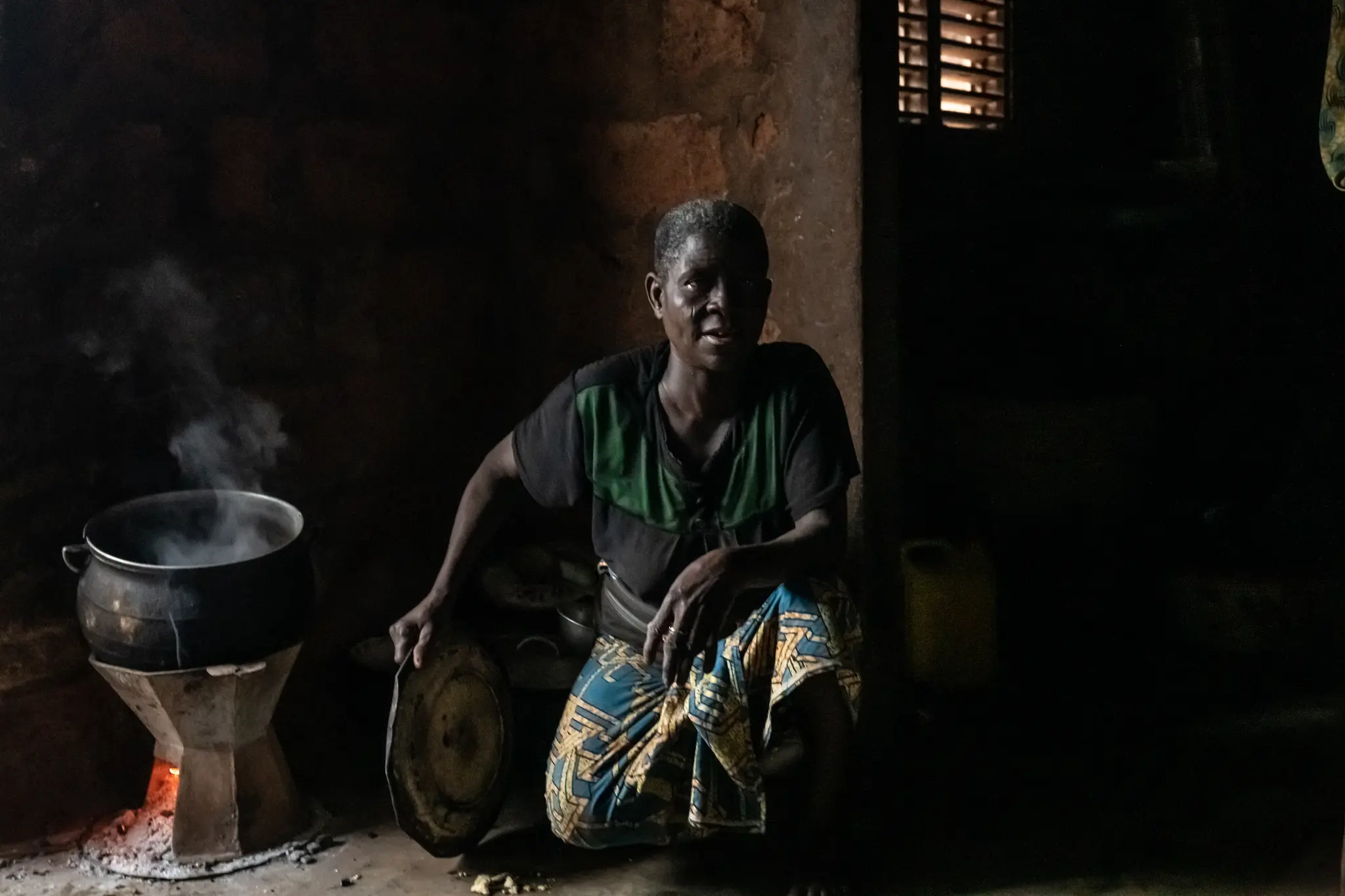
In the first few minutes after I arrived, I felt as if I went back in time 2000 years, and then went through survival training in the army. We were sleeping on the ground or on a cow hide, with no running water or electricity, the food was casava just for the purpose of filling the stomach for a while, the scent of manure, the fear of mosquitos bringing yellow fever or malaria, the heat and humidity, the multitudes of people, all this while wearing long clothing and a mask. And then seeing the difficult conditions for women and children trying to row in water that is crowded with plant life, the work of women boiling salty water in extreme heat just to finally remove grains of salt from the sand, and doing this for 12 hours with a baby on their backs. Having a full view of initiation ceremonies in which self-harm to their bodies is common, and seeing removal of young children from their families to give to the holy temple was gut-wrenching to see, even though they view it as prestigious.
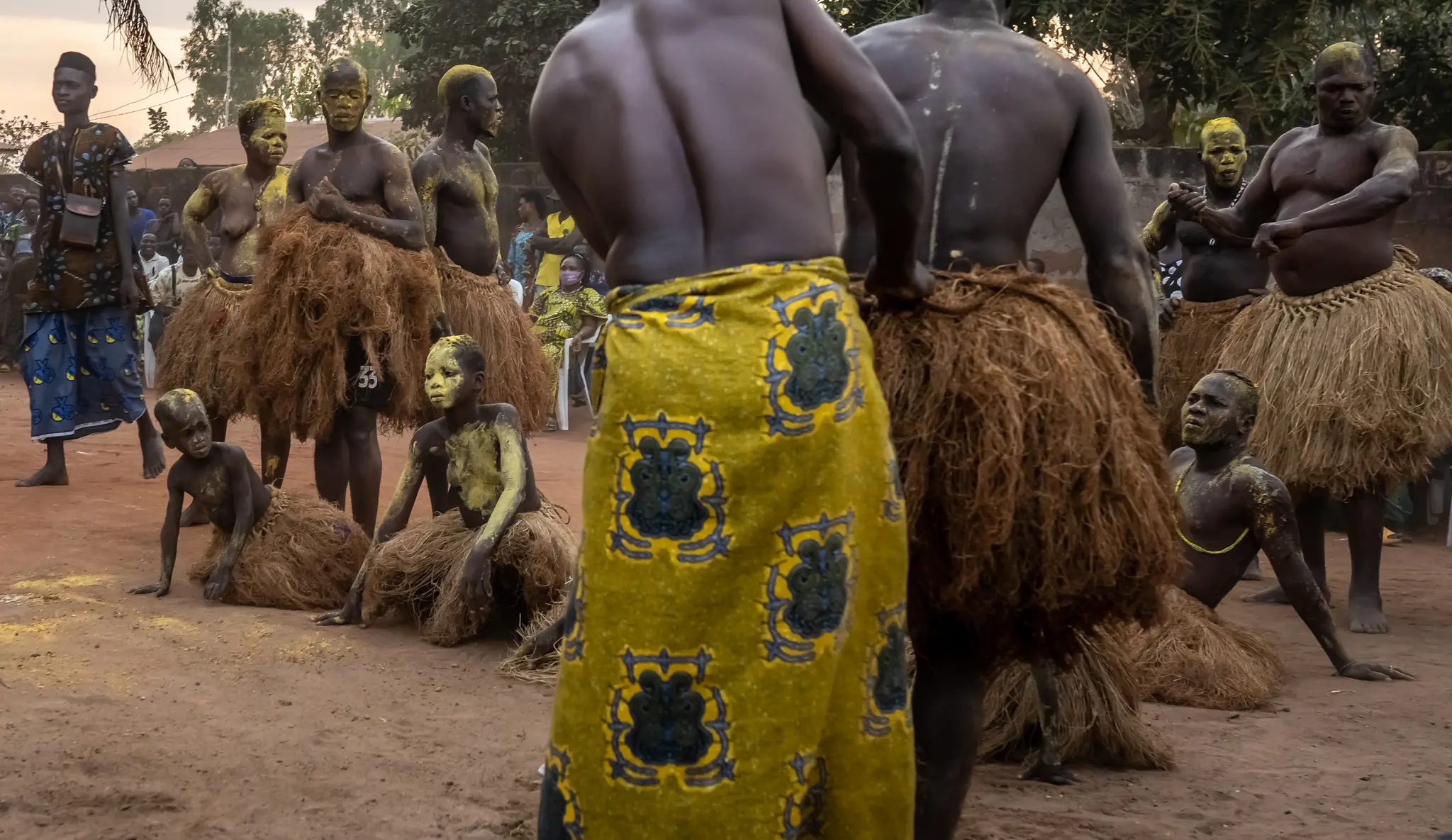
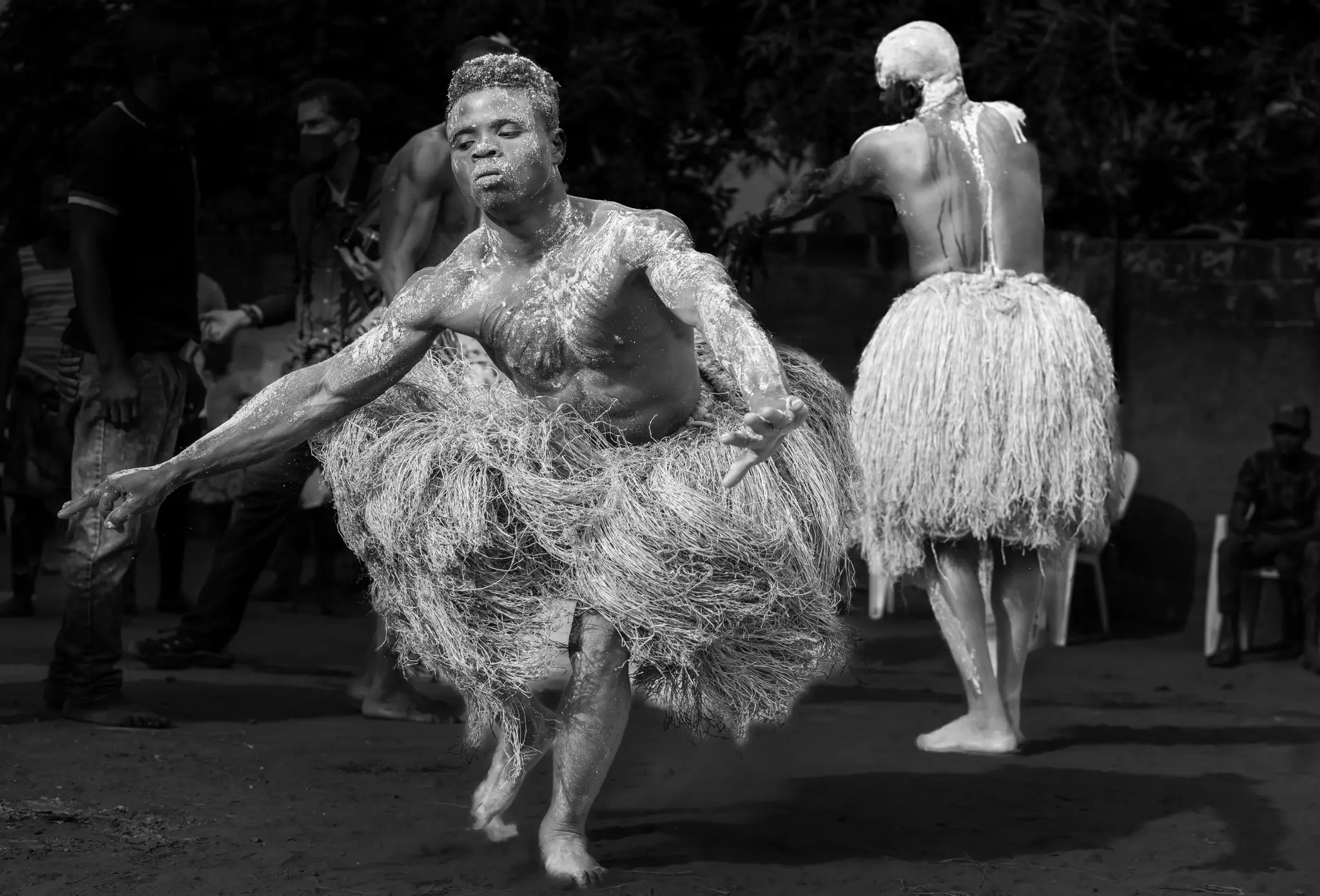
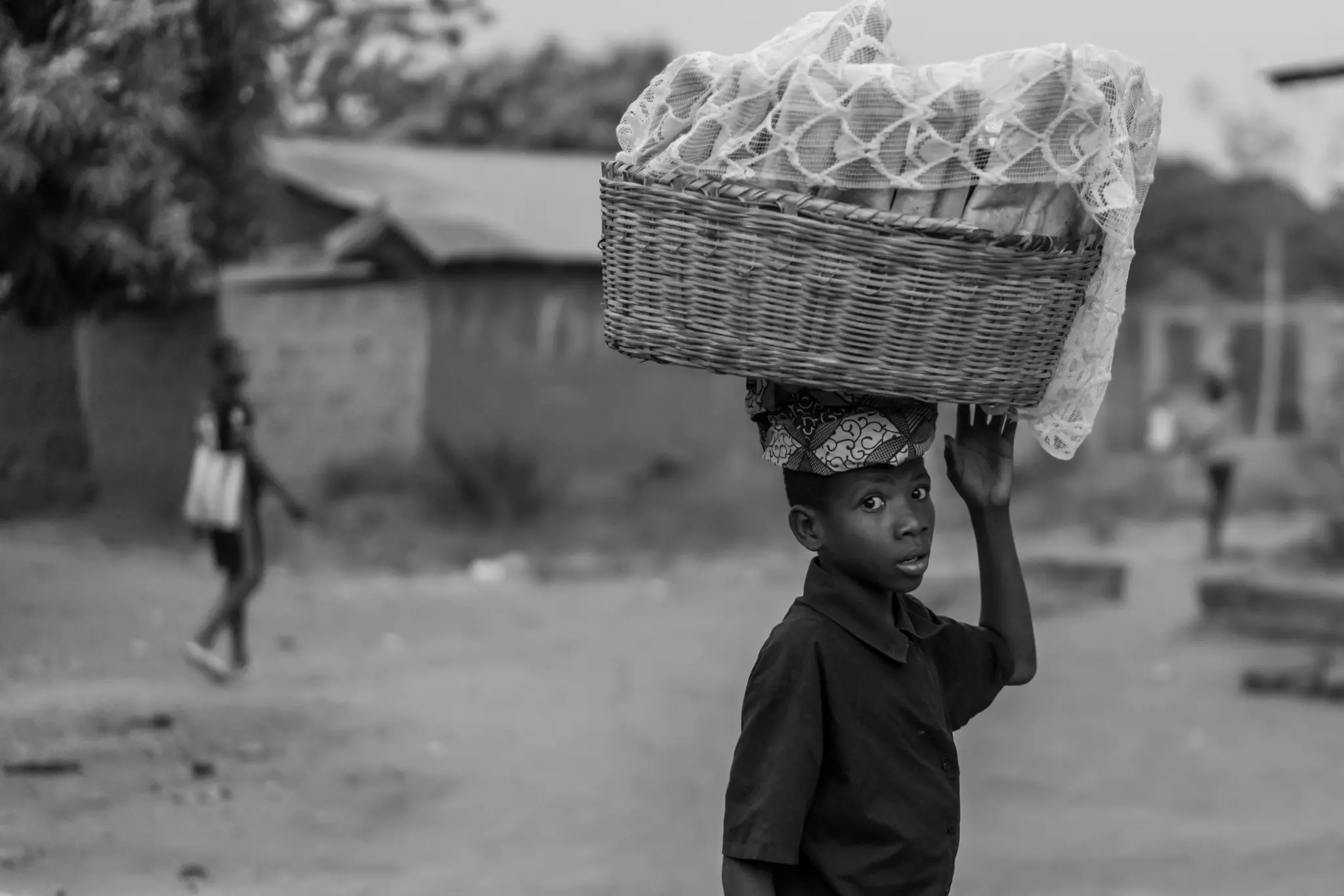
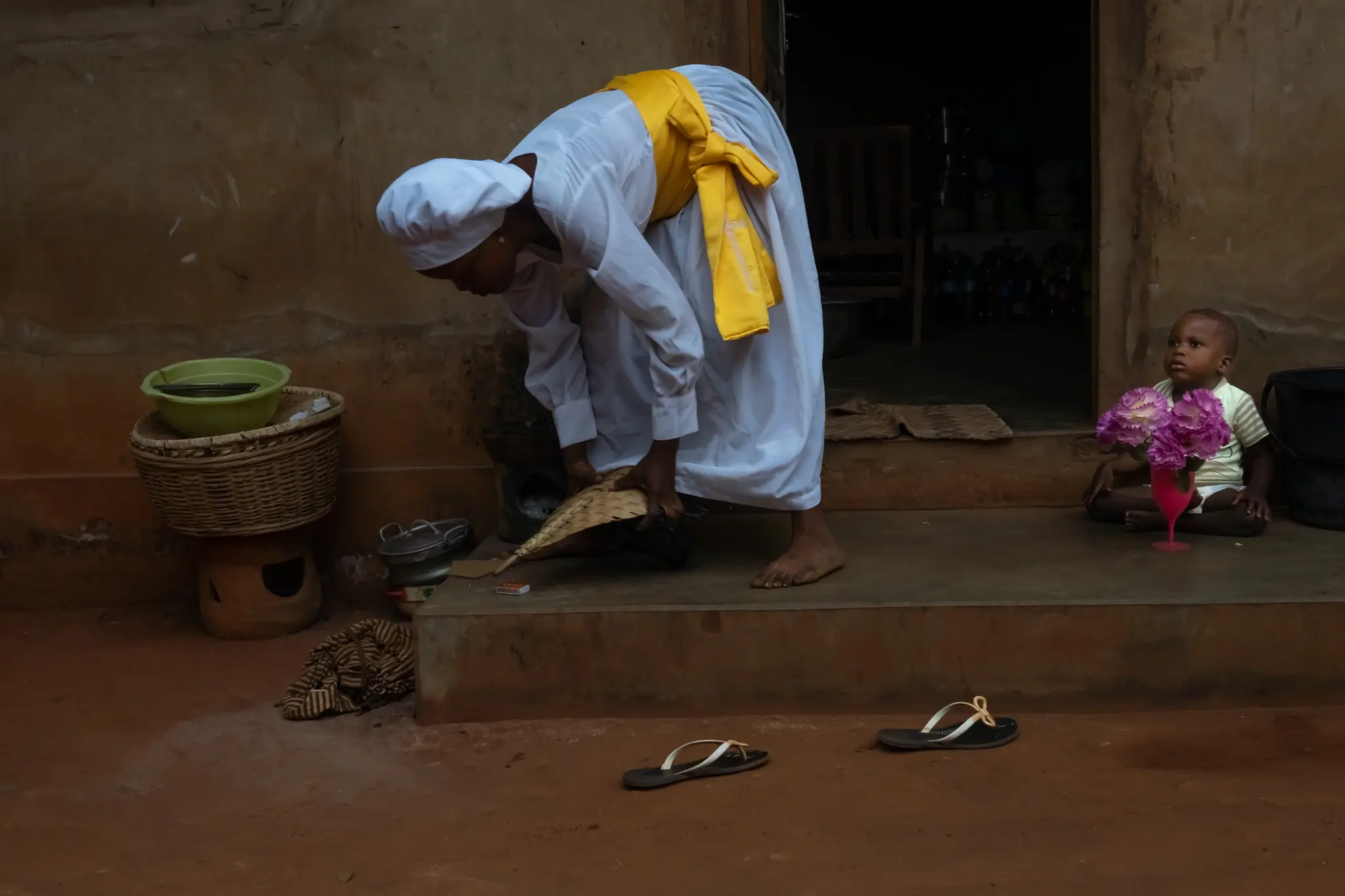
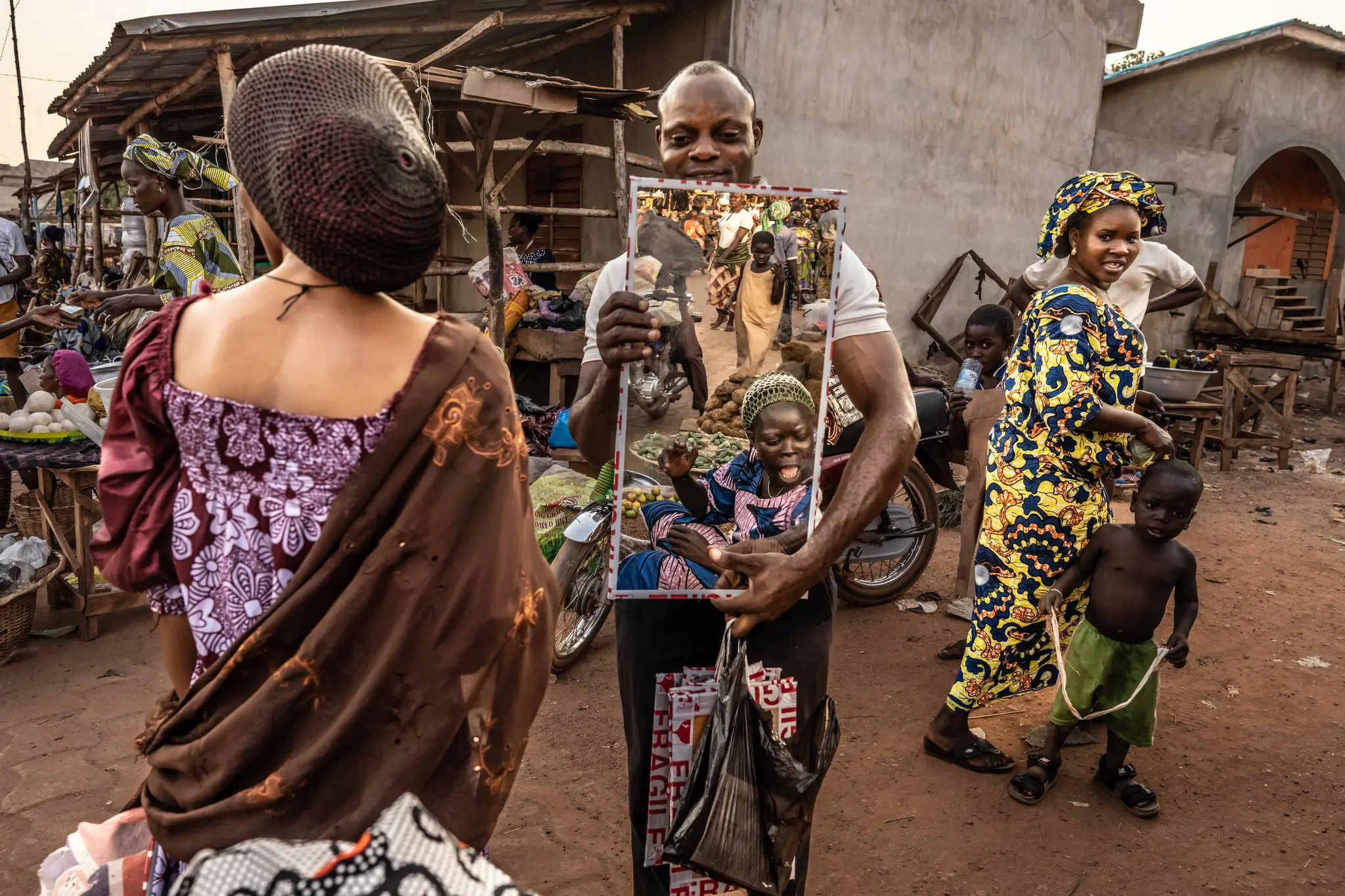
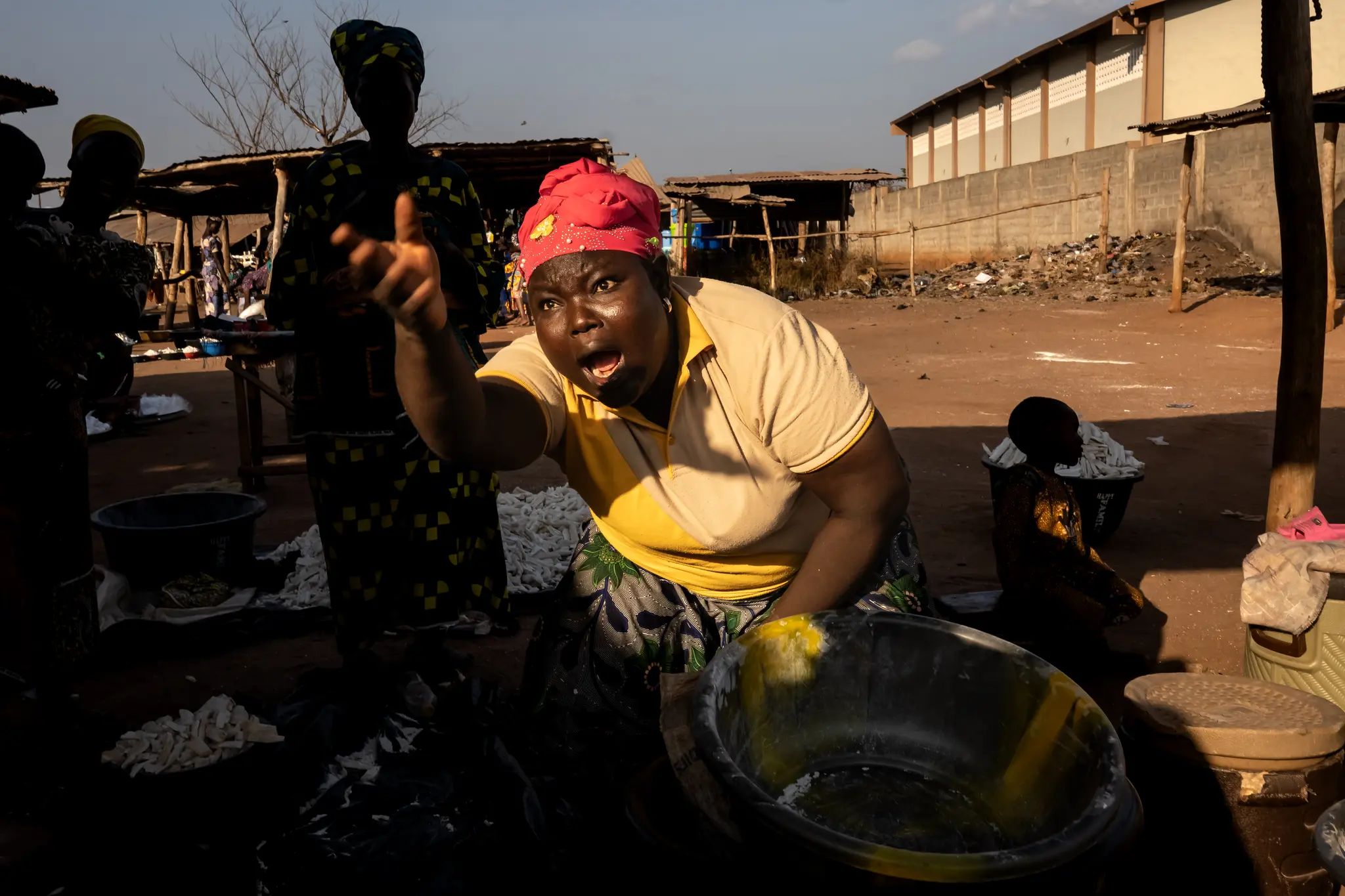
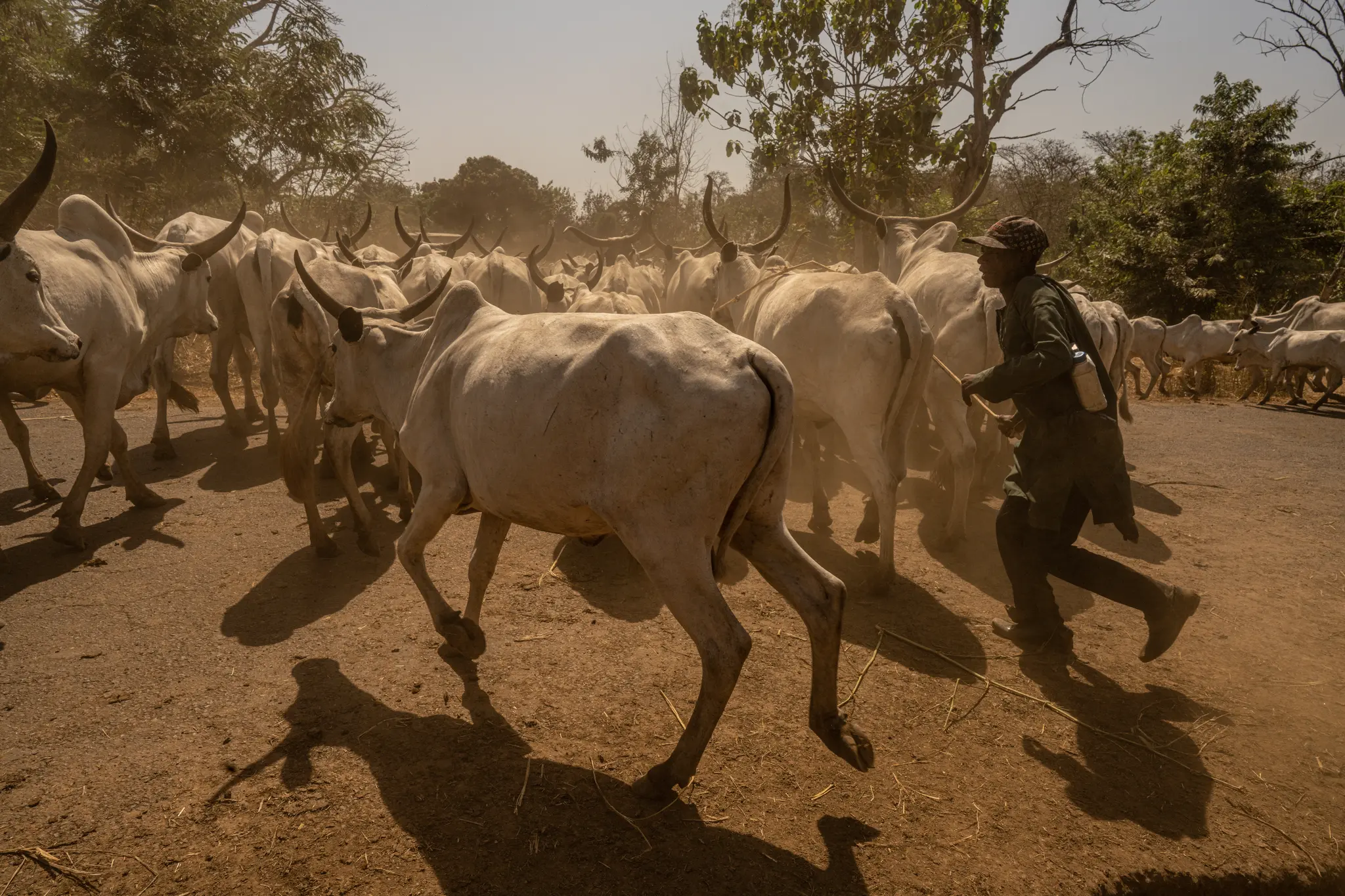
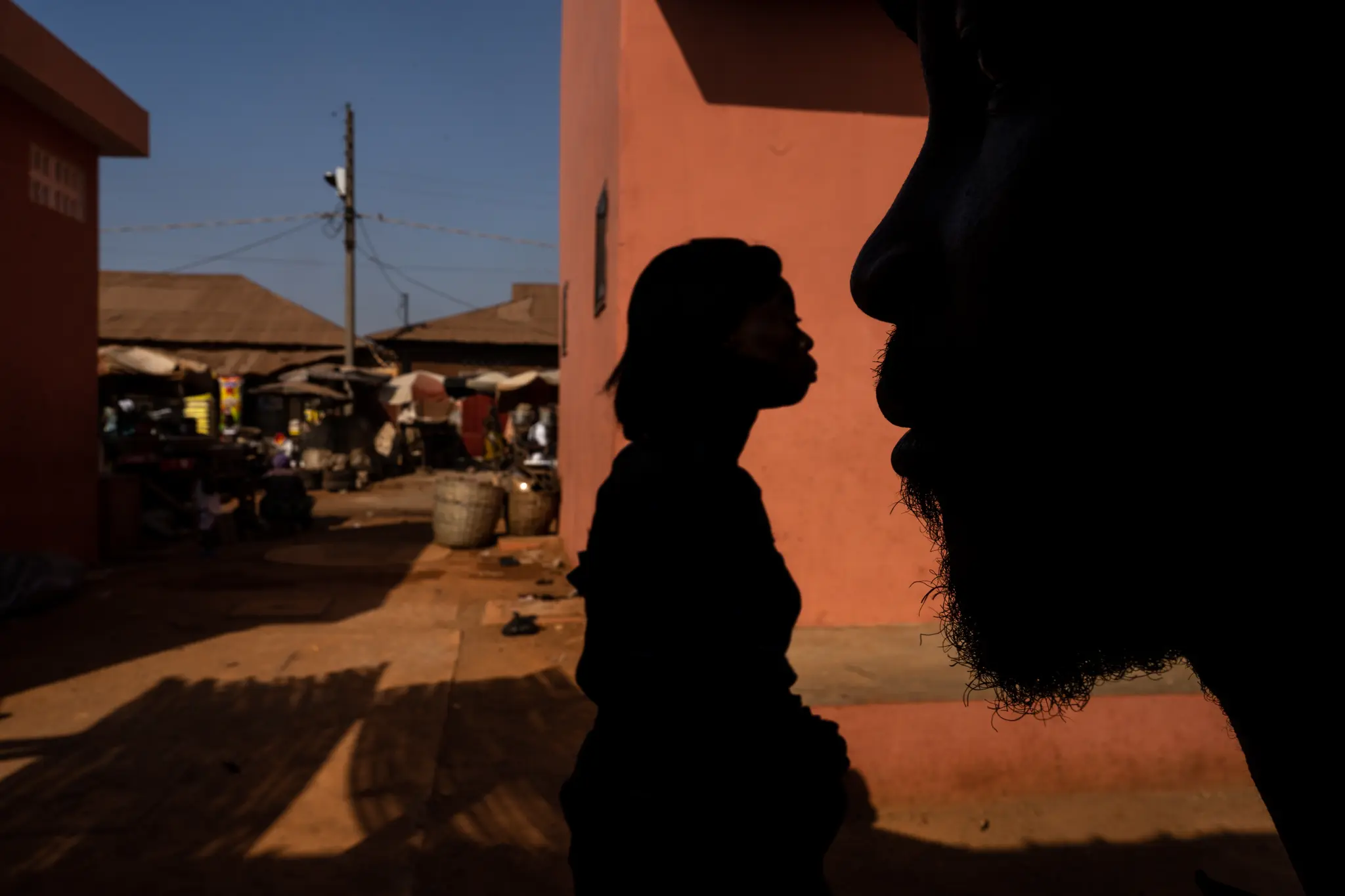
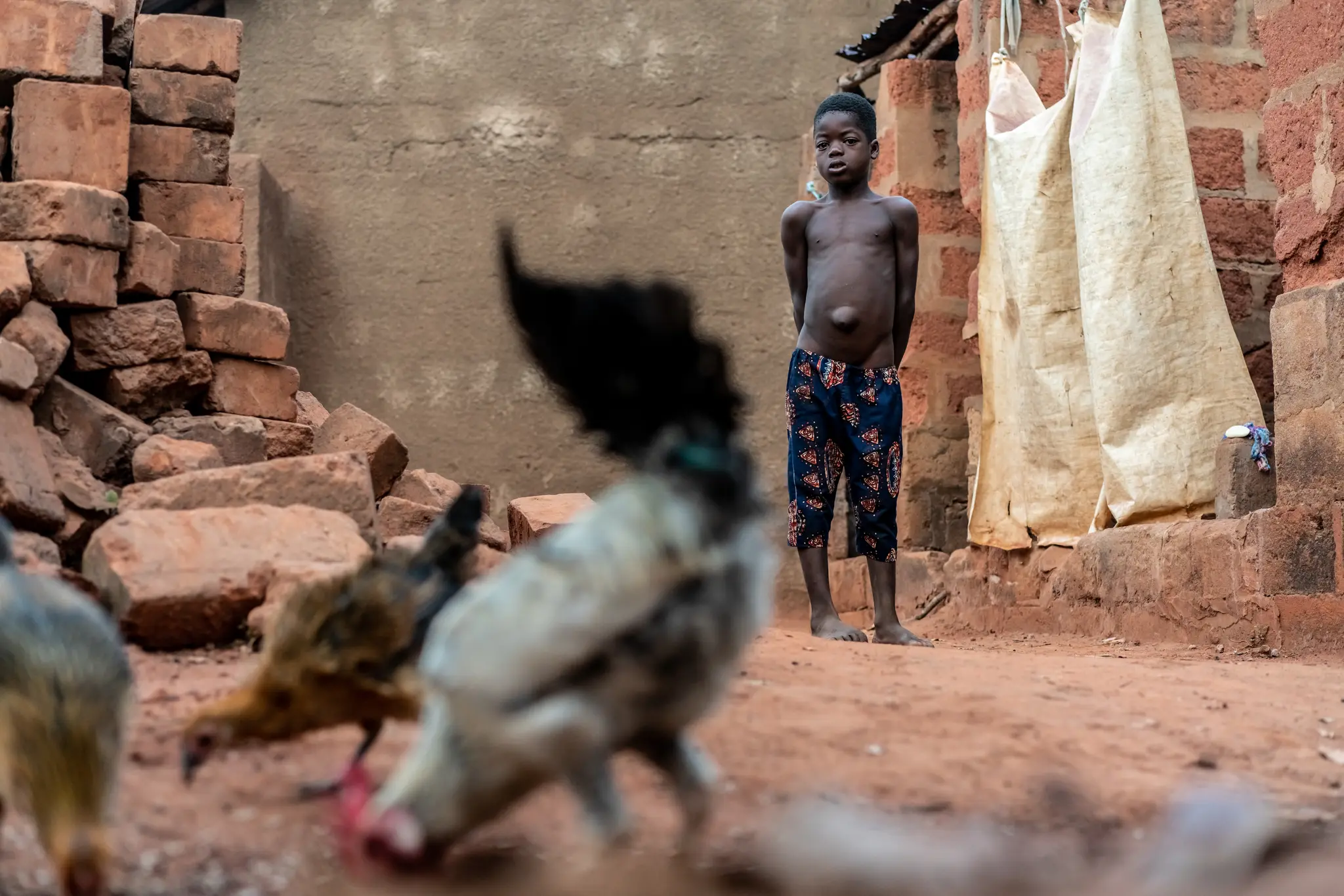
I spent 12 days in Benin with a small group and our role on this trip was to document both day-to-day life and ceremonial life; and for our presence not to be felt while still establishing communication with those being photographed. Sometimes this meant taking pictures of behind-the-scenes of daily life; seeing people watching a ceremony from their window-sills and finding excitement in the discovery of their experience…
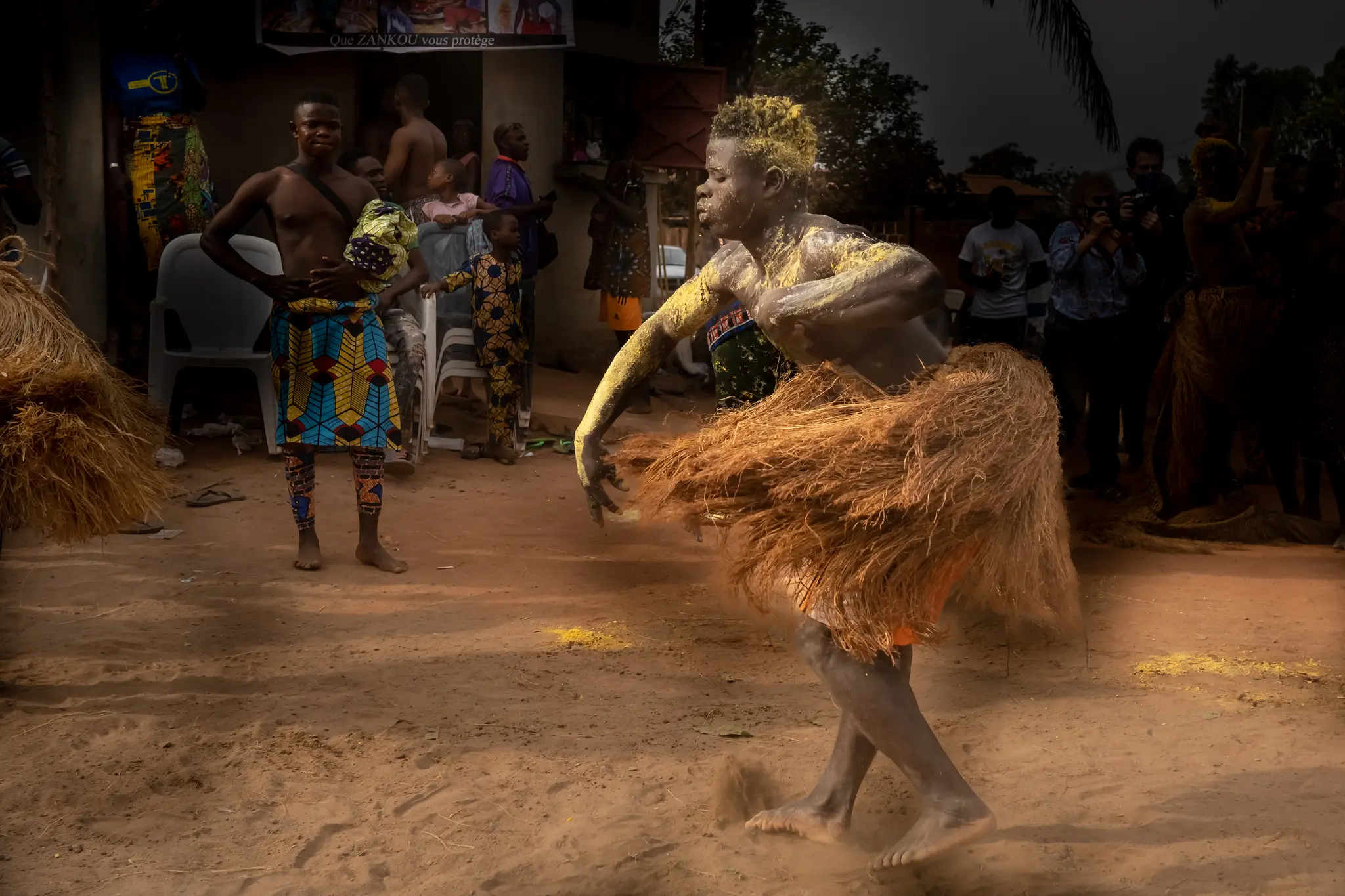
As a participant in a ceremony, I’m standing with my bare feet in the blood that’s spattered from the animal sacrifice because the ground is holy. Rather than acting as a barrier, I felt the camera connected me, caused me to feel, ask, understand, touch all that I experienced.
Benin is one of the poorest countries in the world, producing cotton and palm oil. It is a tall, thin country located in West Africa bordered by Togo, Niger, Nigeria, and Burkina Faso. Benin’s capital is Porto Novo but most people live in Cotounu, both on the water of the Bight of Benin, on the Atlantic Ocean. The population is 11 million and French is spoken, among several local languages. The North is Muslim and the South is Christian, as in the nearby countries. In Benin, the Christians and Muslims also incorporate some Voodoo elements into their beliefs, especially in times of crisis.
Voodoo is a way of life that includes culture, philosophy, language, art, dance, music and medicine. The Voodoo spiritual world consists of Mahou, the supreme being, and about 100 gods – or Voodoos – who represent different phenomena, such as war, illness, healing and earth (Sakpata), storms, lightning and justice (Heviosso) or water (Mami Wata).
Voodoo priests ask these gods to help people by using herbs to cure the sick – or possibly to poison enemies. Priests may ask for offerings, such as a chicken or a sheep, which is then sacrificed to one of the voodoos, or ask that some alcohol be poured onto the ground. You ‘pay’ both when asking for help and when your wish has been granted. People seek help to be forgiven for their sins, to be cured of a disease, to find a job, to close a business deal, to find a spouse or to have a child.
In Western Africa there is a belief that special spirits accompany each family. In Voodoo beliefs, people believe and even see these spirits in nature. They think that each person belongs to a different category of earth, water, fire…
Every place I visited in Benin used to belong to tribes, but is now referred to by the names of their ethnic groups. Each has its religion, laws and beliefs. No group forces its beliefs on the others. All groups believe in one God, but also believe that each individual person in a link in the chain or circle of existence – both live and dead. Each person receives the mission to preserve harmony; any disturbance of this careful balance is of critical importance and deserves a punishment. Human beings must live in peace together and they are required to find solutions to any problem that arises among them. Any issue or difficulty must be examined – why did this happen to me or to us? When a person dies, his or her spirit remains in this life and accompanies the living, as if sitting on their ancestor’s shoulder. For example, a woman is never “alone”; she walks with these spirits watching out for her and so she never feels threatened because no one will dare harm her, or her spirits.
Each individual is responsible for maintaining personal, social and ‘cosmic’ order. Problems are not blamed on others or ideas like ‘global warming’.
They are not solved by the police or in a court of law. This system requires each person to constantly be vigilant in his/her behavior, and to take care that nothing relating to them, or under their control, goes wrong. They believe that life is a miracle that is renewed each day.
If you are sick, you will go to a kind of shaman or folk doctor, a priest or priestess, a person who communicates with spirits or even the head of your tribe. They will ask you, “Why you are you sick?” Or “Why do you continue to be sick? Or “Who has done this to you?” Each of these may tell you to sacrifice a particular animal at a particular place. If this doesn’t work, you will ask again and receive another step to perform. But if, for example, you finally say: “I think it’s the woman who lives across me, who is jealous of me”, you must be very careful as there is a chance she will be taken from her home and killed. And so, it is essential that you behave in a way that ensures no one will be jealous of you, and that you are always kind to everyone. All of this social contract is meant to create a harmonic society whose members will survive and hopefully thrive.
Family life: As I saw the family life there, I thought of my own family: my parents, daughters and baby grand-daughter, and I realized that I was now, at 60, close to the average life span for a woman in Benin, only 62.
The married pair is an economic unit; everyone knows whose partner is whose, and all children belong to the father, even if a woman has a child from another man. The idea is that this child also belongs to the man she is married to now and will become a part of his work force. The men sit together with the men, and the women remain with the women for much of the day. The husband and wife are not meant to be friends, but rather an economic unit that has been arranged by elders.
The practice of having several wives in Africa has its source in slavery; to gain protection, several women could “belong” to one man.
Their thinking goes that men wish to pass on their genes to as many children as possible, and thus enlarge their power by having a number of wives. When a man has a herd of animals, he purposely ensures that his children go farther away to marry, and makes sure to have family members in far places so he can stay there when he goes to that area. In this way he strengthens his family network, and his ethnic group. Women hope that their children will survive and thus seek the protection of the man to whom they’re married.
Every person is born into an existing family and has a position in the larger family network. She or he will fulfill all necessary familial obligations and, in the future, will obtain what is his or her right.
The social contract says that while the children may be beloved by their parents, they have a more important social role to perform – so for example, a girl may be quite young when she is sent to live as a wife in another group, quite far away.
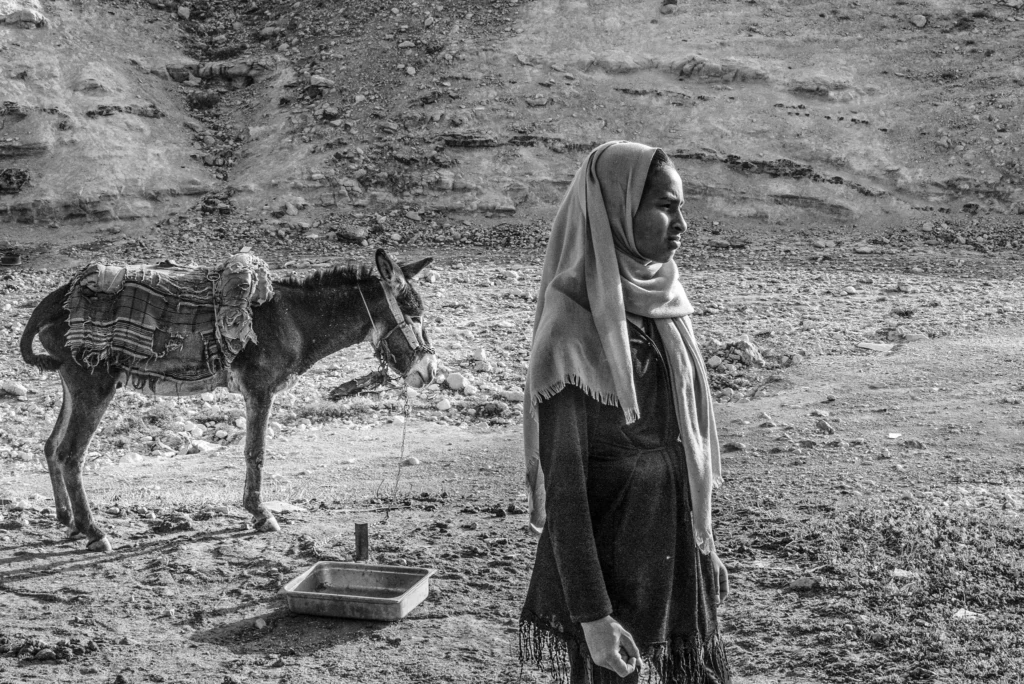
There is another type of thinking that is found in Benin: Any woman who is more or less your mother’s age is also your mother. Similarly, if a man hits his wife, she can go to any man of her father’s age and he must protect her.
The peer group also has great importance: When a man comes home to his wife, the children all leave and go, as a group, to another’s home. This group, of similar ages, stays together and is protected at another woman’s home who acts as their mother. This grouping is an almost ‘holy’ circle of social support and survival. Any food that is prepared belongs to everyone who is there but, as in nature, sometimes there is more for some and less for others.
Female circumcision is still practiced here; at some point the country established clinics where this could be done cleanly, but due to an outcry from Western culture, the clinics were closed. Still this ceremony continues to be done, but now under a tree, in a mud hut, in a cave… Female circumcision is still “sold” in the culture in a way that makes it impossible to resist – you won’t be included in your role as a mother in public ceremonies or you won’t be helped when you give birth… You would ruin the social fabric if you do not follow this practice. Male circumcision is also practiced here, as are initiation ceremonies for young men.
At the seaside at Ouidah there is a place called “Door of no return” from where the most slaves were exported, including 1 million, to America. The market at Abomay is an important historic place on the water, from with enslaved people were sent out. Slaves were people from Benin and other nearby countries who were ‘stolen’ from their homes, sometimes during night-time raids, tied together with ropes and chains, and dragged to the seaside to board ships and be sold as slaves.
This whole slavery enterprise operated over a period of almost 300 years from the 16th to 19th centuries. Powerful kings of what is now Benin directed others to capture and sell people from rival tribes to Portuguese, French and British merchants as slaves bound for Brazil, Haiti and the United States. Benin is now beginning to face this issue, building museums for tourists to visit, though the ruling groups and those groups from who slaves were taken are still in similar positions in their society. Voodoo beliefs can be found in America and Haiti to this day from the slave trade in Benin.
The ceremonies I experienced were so visceral, so real and yet, as a citizen of the Western world, I was thinking about how we communicate and our children play mostly virtually. In Benin, the culture is what’s happening in the street in front of you every day. As a parent and an educator, I wonder about our society and about how photographic language. Kids in the West today relate more to pictures than to text, and I think that people who can’t “read” a picture will be the ones seen as illiterate in the future.
We must all learn how to identify the many layers that each person must understand, that combine the mind and feeling. Texts that we read lead us to imagine the figures; yet when you create a good photograph, the mind creates words in the imagination, you translate the picture into words. In order to know how to read a picture, we must learn the language of photography in order to see better, including the many small details found within the picture and ourselves. What defines a good photo? Something that awakens questions, interest, curiosity about the source of the photo. You see these things and the style via the technical details, the ideas, decoding the messages.
It always seems there is a great difference between the African societies and the modern world in which we live but the basis is very similar; we may all be happy, sad, angry, full of gratitude or compassion and we all express it similarly. Even in our modern, individualistic lives, which we sometimes live at fast pace due to technology, we are still part of a social network.
And yet, I discovered incredible understanding of how we live in comparison with them, on their generosity when there is very little, their acceptance of others, the compassion and kindness in their everyday lives… And how we may act terribly towards one another even when we have so much…